

Wednesday, November 4, 2026
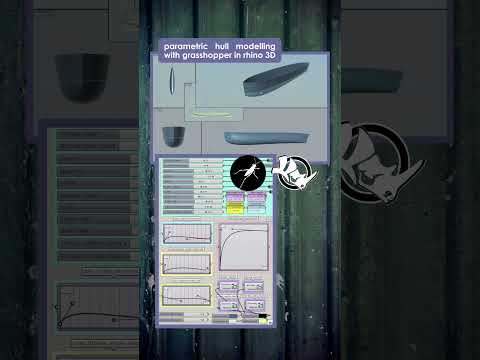
Designing complex boat or ship hulls traditionally required hours of manual curve tweaking and surface reconstruction. However, with the rise of computational design, tools like Grasshopper have transformed how marine architects and 3D designers approach complex geometry. By pairing visual programming with Rhino 3D, you can easily automate and refine parametric hull generation in a fraction of the time.
Understanding Parametric Hull Generation
Parametric hull generation involves using mathematical algorithms and flexible parameters—such as beam width, draft, overall length, and bow entry angle—to define a vessel's hull geometry. Instead of manually dragging individual control points, designers can simply adjust sliders in Grasshopper to instantly update the entire 3D model. This approach allows for rapid prototyping, real-time design variations, and faster hydrodynamics testing.
Why Grasshopper and Rhino 3D Are the Ultimate Pair
As an industry-standard CAD platform, Rhino 3D provides exceptional freeform surface modeling capabilities. When seamlessly integrated with Grasshopper—its built-in visual programming editor—designers gain complete algorithmic control over their surface geometry.
By using Grasshopper for parametric hull modeling, you can: - Iterate Rapidly: Explore dozens of hull variations instantly without recreating geometry from scratch. - Maintain Precision: Ensure exact mathematical control over cross-sectional curves, waterlines, and lofted surfaces. - Optimize Performance: Connect geometry directly to analysis plugins for hydrostatic and structural feedback.
Essential Workflow for Building a Parametric Hull
- Define Key Parameters: Establish numerical input sliders for dimensions like length overall (LOA), beam, and draft.
- Generate Base Curves: Create dynamic cross-section curves and stem profiles driven directly by your parameter inputs.
- Form the Surface skin: Apply lofting or surface-from-network components to generate a smooth, fair hull skin.
- Analyze and Refine: Finetune your sliders to optimize the hull's fairing lines and hydrodynamics properties.
Conclusion
Mastering computational design opens up incredible technical freedom. Whether you are creating sleek luxury yacht concepts or commercial vessel designs, leveraging Grasshopper within Rhino 3D will drastically streamline your workflow and elevate your digital modeling capabilities.


