
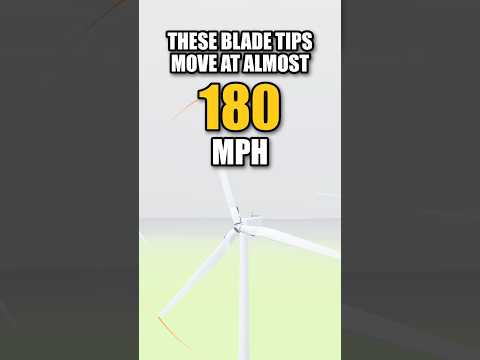
Have you ever looked at a massive wind turbine and thought it was moving in slow motion? It might look like a gentle giant lazily spinning against the skyline, but looks can be deceiving. While the central rotor turns only about 12 times per minute, the outer tips of those giant 200-foot blades are actually slicing through the air at nearly 180 mph!
Understanding how these clean-energy behemoths operate requires a deep dive into modern mechanical design. Through advanced 3D engineering, researchers and designers can now visualize and optimize the complex physics that make this incredible mechanical balance possible.
The Mind-Boggling Physics of Blade Velocity
How can a turbine rotor spin so slowly while its tips move faster than a racing car? It all comes down to rotational mechanics and geometric scale.
Because each blade stretches over 200 feet from the center hub, the outer tip must cover a vastly larger circumference than the inner shaft during a single turn. At just 12 revolutions per minute (RPM), that immense distance forces the blade tips to travel at extreme speeds near 180 mph.
Managing the structural stress caused by these high velocity tips is a major challenge. Blades are crafted from specialized composite materials designed to flex without breaking, enduring heavy aerodynamic loads and extreme weather conditions for decades.
How 3D Engineering Drives Turbine Innovation
Building a machine capable of converting natural wind into stable electrical energy requires extreme precision. Today, sophisticated 3D engineering tools allow mechanical engineers to model fluid dynamics, stress distribution, and internal blade geometry long before physical manufacturing begins.
Inside the housing at the top of the tower (the nacelle), a specialized gearbox converts the slow, high-torque rotation of the main shaft into the rapid rotation needed by the generator. Utilizing 3D engineering simulations, developers can fine-tune gear ratios and automatic pitch control systems—which subtly adjust the angle of the blades to catch optimal wind levels while preventing catastrophic failure during storms.
The Future of Wind Power
As the global demand for sustainable energy grows, wind turbines are becoming bigger, quieter, and more efficient. By combining cutting-edge physics with advanced digital design, engineers are constantly pushing the limits of renewable power—one 180 mph blade tip at a time.
