
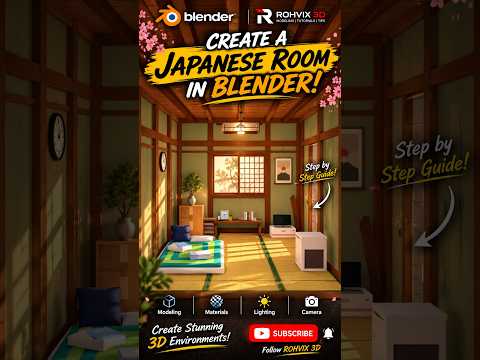
Have you ever wanted to transport your audience into a calm, tranquil space through your digital artwork? Designing a traditional Japanese room is one of the best ways to master spatial layout, lighting, and realistic texturing. In this guide, we will break down the essential steps to bring a detailed 3D environment to life using Blender.
Structuring the Architecture
Every impressive scene starts with a solid foundation. Begin by establishing accurate proportions for your room using basic blockout shapes. Traditional Japanese interior design relies heavily on grid layouts, balance, and natural materials. Focus on modeling core structural elements such as wooden support beams, Tatami mat flooring, and iconic Shoji sliding screens. Pay close attention to real-world dimensions, as correct scaling makes your architectural space instantly believable.
Texturing and Atmospheric Lighting
Once your geometry is locked in, it is time to focus on materials and light. Apply high-quality seamless textures for the rich wood grain, woven grass mats, and translucent rice paper screens. Lighting plays a crucial role in establishing the mood of your 3D environment. Utilize Blender's powerful rendering engines to simulate soft, natural sunlight streaming through the Shoji windows. Adding subtle volumetric lighting or light shafts will immediately elevate the atmospheric depth and warmth of your render.
Adding Prop Details and Final Compositing
To make the room feel authentic and lived-in, populate the space with traditional decor. Add key props such as a low wooden tea table (chabudai), floor cushions (zabuton), a delicate bonsai tree, or a ceramic tea set. Be sure to add subtle bevels to hard edges and micro-imperfections to textures so your assets don't look unnaturally sharp. Finally, set up your camera angle using strong focal points and apply post-processing adjustments in the Compositor to polish the colors.
Conclusion
Creating a Japanese-themed room is an enjoyable project that sharpens your hard-surface modeling, shading, and scene composition skills. With patience and attention to detail, you can transform simple shapes into a breathtaking 3D environment ready for your game portfolio or art reel. Fire up Blender and start crafting your serene scene today!
