
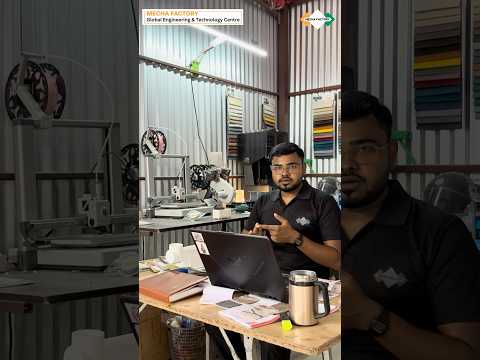
Turning a brilliant concept into a tangible, market-ready product used to take months of painstaking labor and excessive tooling costs. Today, rapid prototyping has completely transformed the hardware landscape. By pairing digital design tools with modern additive manufacturing, engineers and designers can now bring physical prototypes to life in a matter of hours.
From Digital Design to Physical Prototype
Every successful product development journey starts in the digital realm. Designers use advanced 3D CAD software to draft, stress-test, and refine complex geometries before sending them to a physical machine. This digital foundation is critical because 3D printers rely on precise mathematical data to construct objects layer by layer.
By perfecting your model within a 3D CAD environment, you can catch critical design flaws early, optimize structural integrity, and dramatically reduce raw material waste long before entering mass production.
Exploring Key Types of 3D Printers
Once your concept is finalized in software, selecting the right 3D printing technology is essential for accurate functional testing. The three most widely used printer types in product development include:
- Fused Deposition Modeling (FDM): Best suited for early-stage visual concepts and quick structural models using standard thermoplastics.
- Stereolithography (SLA): Utilizes a laser to cure liquid resin into high-resolution components, ideal for parts requiring fine details and smooth surface finishes.
- Selective Laser Sintering (SLS): Uses a high-power laser to fuse polymer powders, creating exceptionally strong, complex functional prototypes without needing support structures.
Accelerating Innovation and Time-to-Market
Seamlessly bridging your 3D CAD workflow with the appropriate modern 3D printing technology gives your team a decisive competitive edge. Physical iterations that previously required weeks of external machining can now be executed overnight in-house. Whether you are an independent creator or part of a enterprise R&D division, leveraging these tools will help you innovate faster, mitigate development risks, and bring better products to market.

