
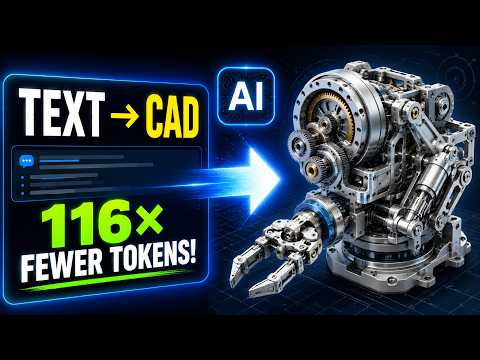
Imagine describing a physical object in plain English and watching a complete, 3D printable file materialize in seconds. What once sounded like science fiction is now becoming a reality through cutting-edge artificial intelligence. Enter MAC (Multi-Agent CAD), an innovative system designed to bridge the gap between simple text prompts and functional manufacturing models.
What is Multi-Agent CAD (MAC)?
Traditional 3D CAD software often requires years of practice, precise mathematical inputs, and complex manual drafting. MAC changes this paradigm by using a collaborative network of specialized AI agents. Instead of relying on a single AI model to guess the exact geometry of an object, MAC splits the workload among multiple intelligent agents. Some agents analyze the text prompt, others generate the underlying parametric code, and additional agents inspect the design to ensure structural viability.
This multi-agent approach allows the system to generate clean, editable, and highly accurate parametric models rather than distorted 3D meshes. By translating descriptive text directly into code-based geometry, MAC creates physical parts that are optimized for production and ready for 3D printing.
Why Text-to-CAD Technology Matters
The integration of generative AI into 3D CAD workflows brings several major advantages to engineers, industrial designers, and hobbyists alike:
- Rapid Prototyping: Turn creative concepts into physical objects without spending hours on initial sketching and baseline modeling.
- Accessibility: Lower the barrier to entry, allowing non-experts to generate custom parts without navigating steep software learning curves.
- Parametric Accuracy: Because MAC produces code-driven geometry rather than mere visual surfaces, the output remains fully customizable, precise, and structurally sound.
The Future of Digital Design
While human expertise remains essential for complex mechanical engineering, tools like MAC represent a massive leap forward for rapid design iteration. The future of 3D CAD is evolving into a hybrid process—one where humans provide creative intent and AI handles the tedious drafting tasks. Whether you are an experienced engineer or a desktop manufacturing enthusiast, text-driven CAD modeling is set to redefine how we bring digital ideas into the real world.

