
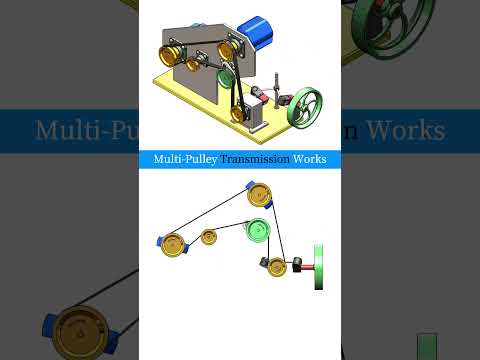
Mechanical power transmission is at the heart of modern machinery, driving everything from household appliances to massive industrial equipment. Among the various methods used to transfer rotational energy, multi-pulley systems stand out for their efficiency, versatility, and mechanical advantage. But how exactly do these intricate systems work under the hood?
The Mechanics Behind Multi-Pulley Systems
A multi-pulley transmission relies on a series of interlinked wheels (pulleys) connected by belts or cables. By altering the relative diameters of these pulleys, mechanical engineers can precisely control speed and torque outputs throughout a machine.
When a smaller drive pulley rotates a larger driven pulley, the output speed decreases while torque increases. Conversely, driving a smaller pulley increases rotational speed at the cost of torque. Combining multiple pulleys allows machines to achieve complex gear ratios, distribute force across multiple axes, and change the direction of rotation seamlessly.
Visualizing Complex Assemblies with 3D CAD
Historically, understanding and designing intricate mechanical assemblies required physical prototypes and manual draft sketches. Today, modern engineers leverage advanced 3D CAD software to model, simulate, and optimize power transmission systems with extreme accuracy.
By breaking down a multi-pulley setup inside a 3D CAD environment, designers can visualize belt tension, analyze stress distribution, and check for spatial clearance issues long before reaching the production floor. This digital precision drastically reduces engineering errors, minimizes material waste, and accelerates the product development cycle.
Practical Applications in Modern Engineering
Multi-pulley transmission systems are ubiquitous across various industries due to their smooth operation and shock-absorption capabilities:
- Automotive Engines: Serpentine belt systems utilize multiple pulleys to drive the alternator, power steering pump, and air conditioning compressor simultaneously.
- Industrial Machinery: Manufacturing equipment relies on multi-pulley setups to regulate conveyor belt speeds and drive heavy machinery.
- Workshop Tools: Drill presses and metal lathes frequently use stepped multi-pulley drives to allow easy speed adjustments depending on the material being worked on.
Conclusion
Whether you are a student, hobbyist, or professional mechanical designer, mastering how power flows through pulley assemblies is fundamental. By utilizing modern 3D CAD tools, complex mechanical concepts become intuitive visual experiences, bridging the gap between theoretical engineering and real-world application.

