
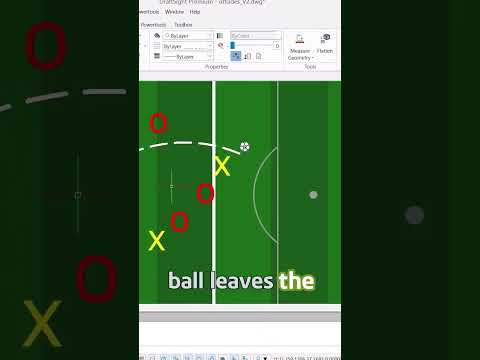
The offside rule in football has sparked endless debates among fans, players, and pundits for generations. With the introduction of modern Video Assistant Referee (VAR) technology, millimeter-precision lines are drawn on-screen to determine whether an attacker holds an unfair advantage. But how do these visual lines actually work geometrically? As it turns out, powerful computer-aided design software can easily demystify the science behind the pitch.
Understanding Offside Lines Through 2D CAD
When viewing a football match through a broadcast camera, perspective distortion can make a parallel line look angled. Determining whether a player is offside requires converting a tilted camera view into a mathematically accurate grid. By leveraging DraftSight, a leading 2D CAD software solution, analysts can project exact reference lines aligned with the pitch boundaries and vanishing points. This geometric approach ensures that camera angles do not trick the human eye.
How DraftSight Transforms Spatial Analysis
Using precise drafting tools, DraftSight enables users to plot accurate reference points, overlay vector lines on freeze-frame footage, and measure distances with complete precision. Beyond analyzing controversial sports moments, this level of geometric accuracy demonstrates the incredible versatility of 2D drafting tools. Whether you are mapping out complex architectural blueprints or calculating precise spatial relationships on a sports field, professional CAD software provides the accuracy needed to make definitive calls.
The Intersection of Sports and Engineering
The relationship between engineering software and sports analytics is growing rapidly. Tools like DraftSight showcase how fundamental CAD principles extend far beyond traditional design offices, offering clarity where human observation falls short. The next time you watch a tight offside call on matchday, remember that geometry and CAD drafting are working behind the scenes to bring absolute precision to the game.
