
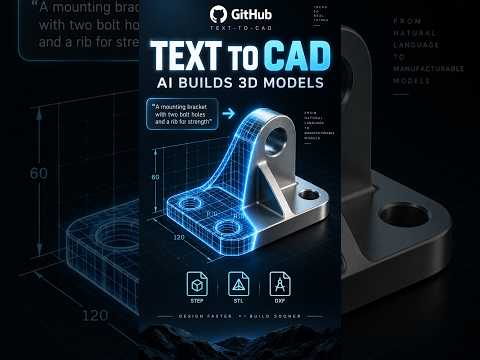
Imagine sitting at your computer and typing, “A 50mm mounting bracket with four symmetrical bolt holes,” and watching a fully functional engineering file appear before your eyes. This isn't science fiction anymore. The emergence of "Text-to-CAD" technology is fundamentally shifting how we approach mechanical design and manufacturing.
For decades, the barrier to entry for professional design has been high. Learning complex software was a prerequisite for turning an idea into a physical object. However, with the integration of Generative AI, the process is becoming as simple as having a conversation. By leveraging natural language processing, designers can now describe mechanical parts in plain English, allowing AI to handle the heavy lifting of geometry generation.
Bridging the Gap Between Concept and Creation
One of the most significant advantages of this technology is the speed of iteration. Traditionally, creating a professional 3D CAD model required hours of technical skill, precise manual input, and a deep understanding of parametric constraints. Now, engineers can generate initial prototypes in seconds. This allows for rapid experimentation, where multiple variations of a part can be tested and refined without the time-intensive process of manual drafting.
Democratizing Professional Design
Furthermore, this AI-driven approach democratizes the design process. Small businesses and hobbyists who may not have mastered professional-grade software can now produce high-quality, manufacturable assets. The ability to generate accurate 3D CAD files from a simple text prompt means that the gap between a concept and a physical prototype has never been smaller. It levels the playing field, allowing the focus to shift from "how to use the tool" to "how to solve the problem."
The Next Frontier of Manufacturing
While we are still in the early stages, the implications for the manufacturing industry are massive. We are moving toward a world where AI doesn't just assist the designer but acts as a collaborative partner. As these models become more sophisticated, they will eventually account for material properties, stress points, and specific manufacturing constraints automatically.
The era of manual sketching is evolving. By embracing AI, we are unlocking a more intuitive and efficient way to build the world around us. Whether you are a seasoned engineer or a curious maker, the fusion of AI and 3D CAD is a frontier that promises to redefine the limits of human productivity.
