
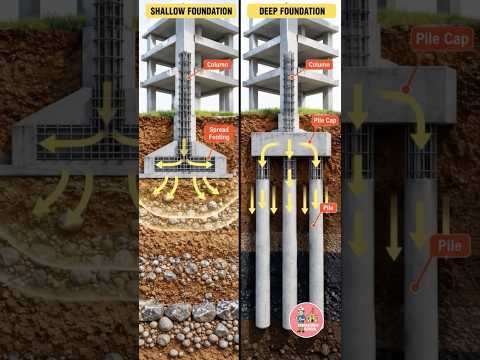
Every great structure starts beneath the surface. For engineers and designers working on infrastructure projects, choosing the right foundation type is the most critical decision in the early stages of design. Whether you are utilizing advanced modeling software like Civil 3D to map out site topography or managing a construction site, understanding the fundamental differences between shallow and deep foundations is essential for structural integrity.
What is a Shallow Foundation?
Shallow foundations, often referred to as spread footings or open foundations, are typically used when the soil near the surface has sufficient bearing capacity to support the structural load. These foundations are generally wider than they are deep, allowing the weight of the building to be distributed across a larger surface area.
Common types include: * Isolated Footings: Used for individual columns. * Combined Footings: Support two or more columns. * Mat or Raft Foundations: A thick slab that supports the entire structure, ideal for soil with low bearing capacity or varying loads.
Shallow foundations are preferred for smaller residential buildings and low-rise commercial structures because they are cost-effective and easier to construct.
What is a Deep Foundation?
When the surface soil is too weak, compressible, or unstable to support a building’s weight, engineers must look deeper. Deep foundations transfer the structural load to a more competent layer of soil or solid rock far below the ground level.
The most common types of deep foundations are: * Pile Foundations: Long, slender members made of steel, concrete, or wood driven into the ground. * Drilled Shafts (Caissons): Large-diameter cylinders created by removing soil and filling the void with reinforced concrete.
These are essential for skyscrapers, bridges, and structures built on expansive clay or near water bodies where soil erosion is a concern.
The Role of Technology in Foundation Selection
In modern engineering, the decision-making process is data-driven. Designers often utilize Civil 3D to analyze surface conditions, grading, and subterranean data. By creating precise digital models within Civil 3D, engineers can visualize how a foundation will interact with the surrounding terrain, ensuring that the transition from the structure to the earth is seamless and safe.
Key Differences at a Glance
- Depth: Shallow foundations are usually placed within a few meters of the surface, while deep foundations can reach depths of 20 to 100 meters.
- Cost: Shallow foundations are significantly more affordable due to less material and simpler excavation.
- Mechanism: Shallow foundations rely on the bearing area, whereas deep foundations rely on end-bearing (resting on rock) or skin friction (grip against the soil).
Choosing the right foundation is a balance of safety, soil mechanics, and budget. By mastering these concepts, you ensure the longevity of every project you build.
