
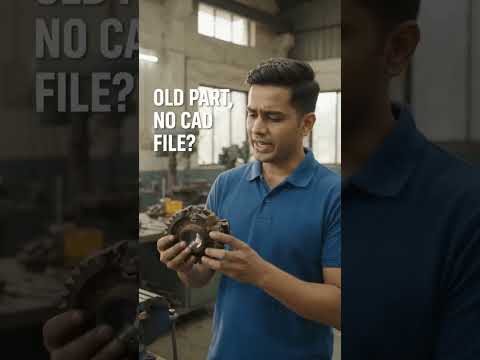
Ever wondered how engineers digitize complex, existing mechanical components without starting from scratch? Whether you are dealing with a legacy part that lacks original blueprints or looking to inspect a manufactured piece for quality control, 3D scanning provides the ultimate solution. By bridging the gap between the physical world and digital design environments, this technology has revolutionized modern manufacturing and engineering.
How Does 3D Scanning Work?
3D scanning is the process of analyzing a real-world object or environment to collect precise data on its shape and appearance. Using lasers, structured light, or tactile sensors, the scanner captures millions of measurements from the object's surface.
These measurements form a dense "point cloud," which software connects into a polygonal mesh. From there, specialized reverse-engineering tools process the mesh to create a fully functional, parametric 3D CAD model. This transition allows designers to edit, modify, or analyze the physical part inside their standard design software.
Key Benefits of Digitizing Physical Parts
Converting real components into digital assets opens up endless possibilities for product development:
- Reverse Engineering: Effortlessly recreate legacy components that no longer have original engineering drawings or design data.
- Quality Control & Inspection: Compare high-resolution scan data directly against original 3D CAD files to detect manufacturing defects, deformation, or surface wear.
- Faster Product Iteration: Scan physical hand-made prototypes to rapidly refine and optimize designs digitally before mass production.
Integrating Scan Data into Your Engineering Workflow
Transitioning physical components into a digital format drastically reduces manual measurement errors and accelerates project timelines. Once your scan data is successfully transformed into a clean 3D CAD file, you can easily perform finite element analysis (FEA), optimize geometry for lightweighting, prepare parts for 3D printing, or generate toolpaths for CNC machining.
Final Thoughts
As modern engineering continues toward full digital transformation, 3D scanning stands out as an indispensable bridge between physical reality and digital innovation. By turning real-world components into accurate 3D models, teams save time, enhance accuracy, and streamline their entire product lifecycle.
