
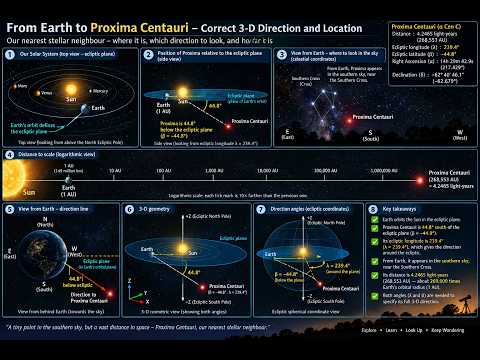
Proxima Centauri, located roughly 4.24 light-years away in the constellation Centaurus, is our solar system's closest stellar neighbor. While it has long fascinated astronomers and space enthusiasts, charting a path to this red dwarf star requires far more than a traditional flat star map. To truly understand where Proxima Centauri sits in relation to Earth, scientists rely on advanced spatial modeling powered by 3D geometry.
Mapping the Stars Beyond Two Dimensions
For centuries, stargazers mapped the night sky using standard two-dimensional coordinates: Right Ascension and Declination. While these measurements work exceptionally well for pointing a backyard telescope, they fall short of capturing the true spatial depth of the universe. Space is vast, deep, and three-dimensional.
By applying 3D geometry to modern astronomical data, researchers can convert flat celestial coordinates into accurate spatial models. This added dimension allows us to calculate not just direction, but the precise distance and physical orientation between Earth, our Sun, and the surrounding stars in the Alpha Centauri system.
Plotting the Cosmic Vector to Proxima Centauri
Determining the exact direction to Proxima Centauri involves calculating a precise three-dimensional vector through space. Astronomers achieve this by combining trigonometric parallax—the subtle shift in a star's apparent position as Earth orbits the Sun—with direct distance measurements.
When these vectors are plotted using 3D geometry, they create an intuitive visual guide of our immediate galactic neighborhood. This spatial perspective clearly illustrates how Earth and Proxima Centauri are situated relative to one another, offering a clear directional path through the cosmic void.
Why 3D Coordinates Matter for Future Exploration
As humanity looks toward interstellar exploration, mastering spatial mapping is becoming increasingly crucial. Concept missions, such as sending ultra-lightweight probes to the Alpha Centauri system, require hyper-accurate trajectory planning. Static 2D maps simply cannot account for long-distance interstellar navigation.
Ultimately, utilizing spatial math bridges the gap between theoretical astronomy and real-world spaceflight. By mapping the universe in three dimensions, we take the first essential steps toward navigating the stars and reaching our nearest celestial neighbors.
