
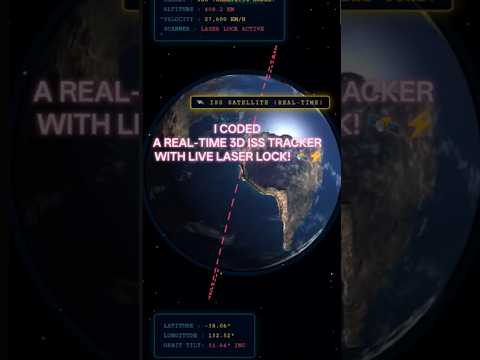
Have you ever wanted to look up at the night sky and pinpoint the exact location of the International Space Station (ISS) in real time? With modern web technologies, rendering dynamic astronomical objects directly in your browser is no longer limited to aerospace engineers. Recently, I set out on an exciting journey to code a real-time ISS satellite tracker from scratch, bringing the wonders of 3D space straight to the web.
The Tech Stack: HTML, CSS, JavaScript, and Three.js
To create a fluid, interactive web application, I leveraged fundamental frontend tech alongside specialized graphics tools:
- HTML5 & CSS3: Provided the user interface overlay for telemetry data, speed counters, and orbital coordinates.
- JavaScript (ES6+): Handled core logic, API requests, and dynamic matrix transformations.
- Three.js: The core engine of the project. This powerful WebGL library made it effortless to render custom 3D models, textures, ambient lighting, and realistic camera physics.
Bringing the Station to Life in 3D Space
Building a satellite tracker requires far more than placing a static model on a screen. To accurately portray objects moving through 3D space, the application connects to live telemetry APIs to gather current space station coordinates.
Using Three.js, I constructed a high-resolution 3D Earth featuring custom specular maps for ocean reflections, an atmospheric glow, and a realistic cloud layer. The ISS model updates its position continuously relative to Earth, giving users a captivating perspective of its orbit at over 17,000 miles per hour.
Key Features of the Tracker
- Live Telemetry Tracking: Real-time updates for latitude, longitude, altitude, and velocity.
- Interactive 360-Degree Controls: Zoom, pan, and rotate around Earth to inspect the ISS from any angle.
- Realistic Sun Lighting: Dynamic directional lighting simulates real-world day and night cycles across the globe.
Final Thoughts
Developing this application was an inspiring project that combined creative coding with space physics. If you want to expand your coding skills, building interactive environments in 3D space using JavaScript and Three.js is a fantastic journey to undertake. Try coding your own orbital visualization today!
