
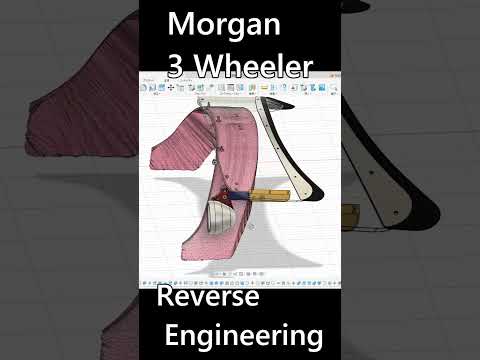
The Morgan 3 Wheeler is an iconic blend of vintage charm and raw motoring enthusiasm. However, when it comes to custom aftermarket modifications, off-the-shelf parts rarely exist. To overcome this challenge, modern automotive builders are turning to digital workflows to design bespoke components—such as a custom folding windscreen—with surgical precision.
From Physical Car to Digital Scan
The reverse engineering process begins by capturing the unique, organic contours of the vehicle. Using high-precision 3D optical scanners, millions of data points are collected to generate a highly accurate point cloud of the car’s front bodywork and cowl section. This non-destructive scanning process ensures every subtle curve and factory mounting point is recorded down to the millimeter, creating a flawless digital foundation.
Refining the Design with 3D CAD
Once the physical geometry is digitized, the scan data is imported into modern 3D CAD software. Working within a parametric digital environment allows engineers to transform raw mesh data into clean, functional solid models.
When designing a complex feature like a custom folding windscreen, 3D CAD provides the ultimate platform to simulate mechanical movement, test hinge clearances, and refine aesthetics. Engineers can evaluate how the glass tilts, verify frame alignment, and make real-time adjustments before committing to physical prototyping or CNC machining. This digital sandbox drastically cuts down on trial-and-error, saving both time and expensive materials.
Bringing Custom Concepts to Life
By combining state-of-the-art scanning tools with advanced 3D CAD design techniques, custom fabrication enters a new era of speed and accuracy. Whether you are building a custom folding windscreen or prototyping intricate engine components, digital reverse engineering eliminates guesswork and delivers a factory-quality finish for custom automotive builds.
