
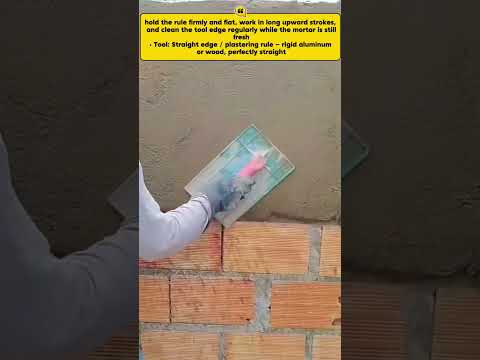
Achieving a smooth, professional finish on brickwork is the hallmark of a skilled tradesperson. While many beginners focus solely on the consistency of the mortar mix, the secret to a truly flat surface lies in the tools and the technique used during the leveling phase. If you want to master the art of rendering, understanding the mechanics of the plastering rule is essential.
The Role of the Plastering Rule
A plastering rule, also known as a straight edge or screed, is more than just a piece of metal; it is a precision instrument. Its primary function is to act as a guide that spans across the uneven surface of the wall. When you apply your base coat of mortar, the thickness is rarely uniform. By using a rigid straight edge, you create a mechanical reference point that bridges the "peaks" and "valleys" of the wet material, allowing you to see exactly where the wall needs adjustment.
Technique: Pulling and Leveling
The magic happens in the movement. The rigid straight edge acts like a precision guide as you work. As you pull the rule upward across the wet mortar, the sharp, rigid edge shears off excess material. This action does two things simultaneously: it flattens the high points and reveals where more mortar is needed.
For those serious about high-quality rendering, this step cannot be rushed. You must maintain consistent pressure and a steady angle to ensure the rule doesn’t "dig in" or skip over the surface. The goal is to let the tool do the heavy lifting of identifying imperfections that the human eye might miss.
Achieving the Perfectly Flat Result
Once the excess is removed, you can use that same material to fill in any voids or hollows identified by the straight edge. This cycle of screeding and filling continues until the rule glides across the wall without leaving gaps behind it. This process ensures that your final surface is not just smooth to the touch, but geometrically flat.
Mastering these fundamentals will significantly improve the durability and aesthetic of your masonry work. By treating your straight edge as a precision guide, you ensure that your rendering projects stand the test of time and look flawless under any lighting conditions. Whether you are a DIY enthusiast or a professional looking to sharpen your skills, the key to success is patience and the right tool for the job.
