
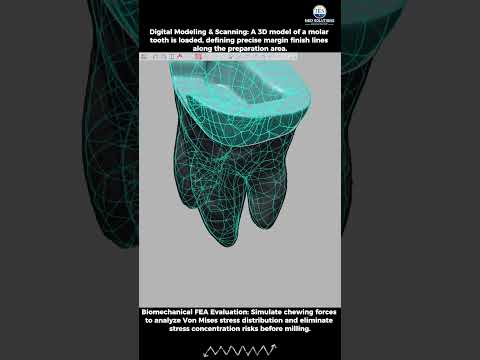
Modern dentistry is undergoing a massive digital transformation, where cutting-edge engineering meets restorative care. Among the most impactful innovations is the integration of advanced 3D CAD technology into crown preparation and biomechanical analysis. By combining precise digital scans with Finite Element Analysis (FEA), dental professionals can now design and evaluate restorations with unprecedented accuracy before ever placing them in a patient's mouth.
Setting the Standard: Precision Margins on Digital Scans
A successful dental crown relies heavily on accurate margin definition. Using high-resolution 3D scans of a molar, practitioners can establish exact preparation boundaries with extreme clarity. This digital foundation eliminates the traditional margins of error associated with conventional physical impressions. By visualizing the exact geometry of the prepared tooth, clinicians ensure an optimal fit, superior marginal integrity, and long-term retention of the crown.
Biomechanical Engineering: The Power of FEA Stress Analysis
Designing an aesthetically pleasing crown is only half the battle; the restoration must also withstand the heavy biomechanical forces of chewing and grinding. This is where modern 3D CAD modeling and Finite Element Analysis (FEA) come into play.
FEA simulates real-world physical stresses directly on the virtual molar and crown model. The analysis highlights areas of high pressure, structural strain, and potential points of material failure. By analyzing stress distribution under various occlusal loads, dental technicians and engineers can refine crown thickness, adjust margin geometry, and select the ideal restorative material tailored to the patient’s specific bite dynamics.
Streamlining the CAD/CAM Dental Workflow
The synergy between digital design and mechanical simulation streamlines the entire CAD/CAM workflow. Instead of relying on trial and error or standardized assumptions, dental teams leverage 3D CAD insights to predict material performance accurately. The results speak for themselves: faster turnaround times, fewer chairside adjustments, and a significantly lower risk of structural crown fractures over time.
As biomechanical stress analysis becomes standard practice, digital crown preparation is setting a new benchmark for predictable, durable, and patient-specific dental care.
