
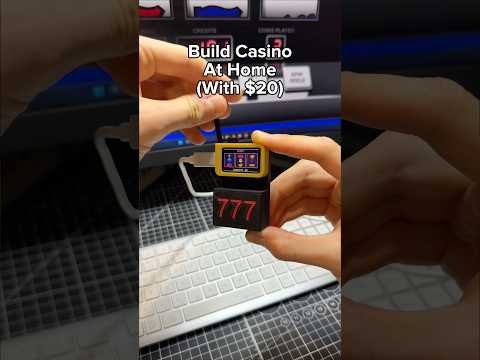
Have you ever wanted to bring the excitement of an arcade right to your desk? Thanks to the evolution of maker technology, building a functional mini slot machine is no longer limited to industrial manufacturing facilities. By combining microcontrollers with modern 3D engineering, hobbyists and makers can now design, print, and program their very own fully working gaming devices at home.
Here is a breakdown of how physical design, electronics, and code come together in this ultimate DIY project.
Designing the Structure with Precision
The backbone of any functional mechanical project lies in precise CAD design. Creating a mini slot machine requires custom-fitted enclosures, smooth-spinning reel mechanisms, coin slots, and mounting brackets for electronics. Through practical 3D engineering, you can iterate rapidly on digital models, ensuring every gear meshes smoothly and every component fits snugly. Using desktop 3D printers, these intricate mechanical parts are brought into reality with high accuracy, allowing for a compact yet sturdy build.
Integrating the Brains: Arduino and ESP32
A slot machine isn't complete without its digital logic. Powerful microcontrollers like the Arduino or ESP32 act as the central brain of the build. These compact boards drive the stepper motors that spin the reels, process inputs from push buttons, and trigger engaging sound effects and LED light displays. Utilizing an ESP32 even introduces Wi-Fi capabilities, opening doors for custom digital scoreboards, online leaderboards, or remote configurations.
Bridging Software and Mechanical Hardware
The true beauty of this project is how seamlessly software meets physical motion. Code running on the microcontroller dictates reel rotation speed, random number generation for win/loss logic, and user feedback. When aligned with precise mechanical tolerances—a key benefit of modern 3D engineering—the result is an interactive, tactile device that delivers genuine entertainment.
Ready to Start Your Build?
Creating a working 3D-printed slot machine is an ideal project for anyone looking to level up their skills in rapid prototyping, circuit design, and embedded programming. Grab your favorite CAD software, fire up your 3D printer, and start turning your creative engineering concepts into reality!
