
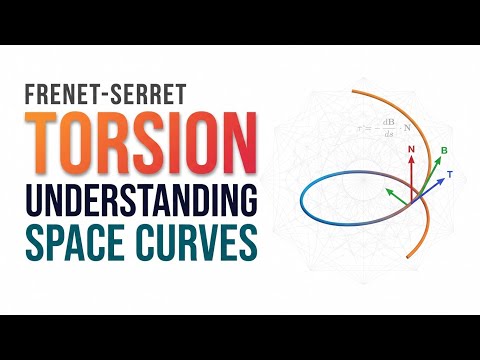
Have you ever wondered what turns a simple, flat curve into a dynamic spiral? While elementary geometry focuses on shapes drawn on a flat sheet of paper, real-world physics and advanced mathematics operate in three dimensions. When a curve lifts off a flat 2D plane and begins twisting through 3D space, basic concepts like standard curvature are no longer enough to describe its path. To fully understand this movement, we need the concept of torsion.
Understanding Curvature vs. Torsion
To grasp torsion, it helps to contrast it with curvature. Curvature measures how sharply a line bends within a single plane—think of turning a steering wheel while driving along a flat racetrack. Torsion, on the other hand, measures how much a curve twists out of that flat plane.
Imagine driving along a winding mountain pass. Curvature accounts for the left and right turns along the road surface. However, if the road starts spiraling upward or twisting along a hillside, you are experiencing torsion. It is the precise mathematical measurement of how a trajectory breaks free from a flat plane and maneuvers through 3D space.
The Mechanics of the Frenet–Serret Formulas
Mathematically, differential geometry analyzes these complex movements using the Frenet–Serret formulas. These foundational equations establish a moving reference frame along a curve, defined by three mutually perpendicular unit vectors:
- Tangent Vector (T): Points directly in the direction of forward motion.
- Principal Normal Vector (N): Points in the direction the curve is bending.
- Binormal Vector (B): Perpendicular to both the tangent and normal vectors, creating a reference vector for the local plane of motion.
As an object moves along a curve, this vector frame continuously rotates and shifts. The rate at which the Binormal vector rotates indicates the exact amount of torsion present. The Frenet–Serret formulas connect these vectors into an elegant system of differential equations, providing a complete description of the curve's geometric behavior.
Practical Applications of Torsion
Torsion is far more than a theoretical calculus topic; it is an essential tool in applied science and technology. Structural engineers use torsion equations to analyze stress on helical staircases, DNA strands, and suspension bridge cables. In computer graphics and game development, programmers utilize torsion to smooth out camera movements and generate realistic fluid trajectories. Furthermore, aerospace engineers rely on these principles to calculate efficient trajectories for satellites and aircraft traveling through 3D space.
By understanding torsion and the Frenet–Serret formulas, you gain a powerful framework for analyzing the mathematics of motion, vector calculus, and spatial geometry.
