
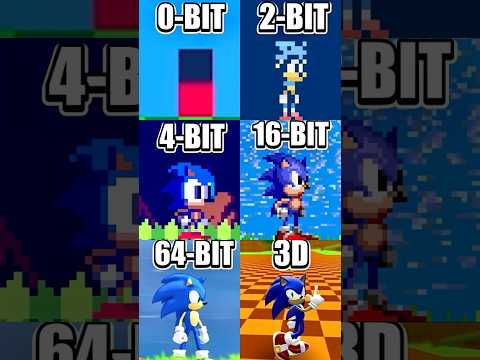
Since his debut in 1991, Sonic the Hedgehog has been the ultimate symbol of speed and attitude in the gaming world. However, the "Blue Blur" we see today is a far cry from the flickering pixels of the early nineties. To truly appreciate how far our favorite hedgehog has come, we need to take a nostalgic trip through a "bit battle" that tracks his transformation from a primitive concept to a modern icon.
The Era of Pixels and Sprites
In the beginning, Sonic’s design was constrained by the hardware of the time. The evolution starts with theoretical 0-bit and 2-bit interpretations—simple, blocky shapes that capture the essence of Sonic using minimal data. As we move into the 8-bit era of the SEGA Master System and Game Gear, we see the birth of the iconic silhouette, though limited by a small color palette and basic animations.
The true "Golden Age" for many fans arrived with the 16-bit power of the SEGA Genesis. This era introduced fluid animations and vibrant environments that allowed Sonic’s speed to truly shine. The jump to 32-bit and 64-bit further refined these sprites, adding layers of detail and smoother movement that pushed 2D art to its absolute limit.
The Leap into 3D Graphics
The most significant turning point in the franchise occurred when the series moved away from flat planes and embraced the world of 3D graphics. This transition wasn't just a visual upgrade; it changed the very nature of how we experience speed. With the introduction of 3D graphics, players could finally explore the environments of Green Hill Zone and beyond from every angle, bringing a sense of scale and immersion that was previously impossible.
Modern titles have taken this even further. Today’s hardware allows for high-fidelity 3D graphics that feature dynamic lighting, realistic textures, and complex physics. Whether he is running through a futuristic city or a lush jungle, the depth provided by modern rendering techniques makes Sonic feel more alive than ever before.
Why the Evolution Matters
Watching the progression from a handful of pixels to a fully realized cinematic character is a testament to the rapid advancement of technology. This "bit battle" highlights not just the technical achievements of developers, but the enduring design of a character who remains recognizable whether he is composed of four blocks or four million polygons. As hardware continues to evolve, one thing remains certain: Sonic will keep running toward the next visual frontier.
